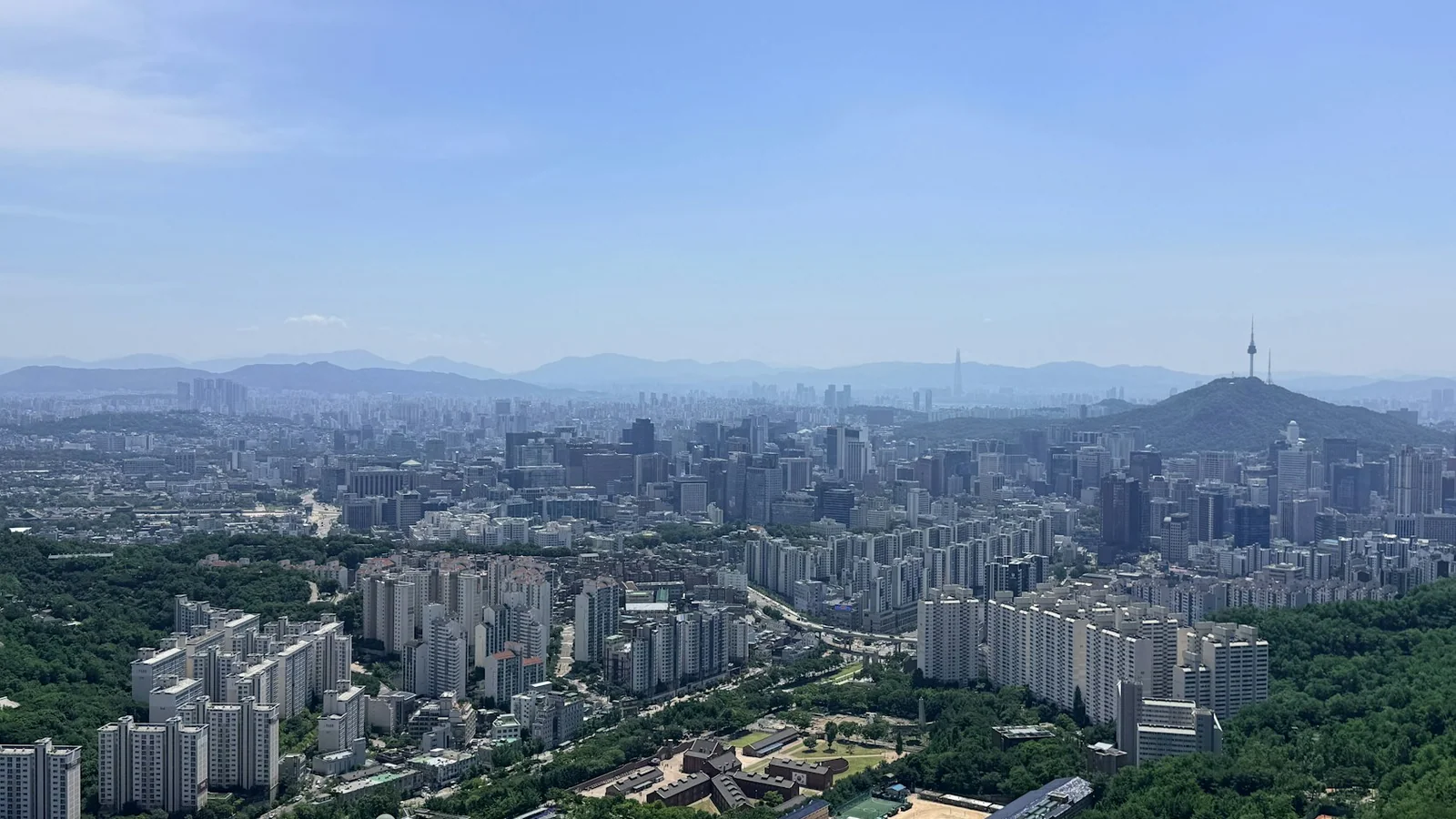
A small apartment's advertised monthly rent is only part of the money you need to live in South Korea. For a concrete Seoul reference, an April 2026 analysis of registered March leases put small-room rent at ₩710,000 a month after standardizing the deposit to ₩10 million. That does not mean a landlord is currently offering you a room for those terms. It shows why a newcomer can have enough income to pay monthly rent but still lack the cash to move in.
There are other measurable expenses. A basic Seoul subway-card ride costs ₩1,550, so 44 such rides cost ₩68,200. Busan's short-distance metro fare is ₩1,600, and the transit products differ. The calculations below show what those numbers buy—and what they do not.
Where the ₩710,000 Seoul rent figure comes from
In its 23 April 2026 report, Yonhap described housing platform Dabang's analysis of rentals registered with South Korea's Ministry of Land. For March 2026 Seoul multi-household and row-house one-room homes of 33 m² or less, Dabang reported a ₩710,000 average monthly rent, normalized to a ₩10 million deposit. It adjusted monthly payments using the rental-deposit conversion rate for leases whose deposits were below ₩100 million. These were past transactions in a limited housing type, not all of Seoul's apartments, a median, today's offers or a market quote for a particular foreign renter.
For perspective, that same analysis put Gangnam District's equivalent small-room average at ₩1,000,000 per month, again on the comparable standardized-deposit basis. The ₩290,000 monthly difference is ₩3,480,000 over twelve months if both reference amounts stayed unchanged. This is a district-versus-city-average comparison, not two matched homes; location, size and lease details still differ. The figure does not establish anything about current Busan rent. A lower published rent is not proof that a specific home is affordable or available.
A ₩10 million deposit is not a monthly bill
Seoul's official housing explanation distinguishes two arrangements. With wolse (월세), a renter normally provides a refundable deposit and pays monthly rent. With jeonse (전세), the deposit is much larger and normal monthly base rent may be zero. Jeonse is not free accommodation: it locks away capital, can generate loan interest and carries a risk that the landlord cannot repay it.
The standardized ₩10 million deposit in the March study is a comparison convention, not evidence that a real one-room apartment is available with precisely that deposit. But its scale makes the arrival-cost problem clear. If a real lease specified a ₩10 million refundable deposit and ₩710,000 first month's rent, just those two payments would require ₩10,710,000 before brokerage, management charges, heating, utilities, furniture or temporary accommodation. The cash needs and payment dates are lease-specific; a landlord may require a portion of the deposit when signing and the remainder before move-in.
Someone taking a jeonse lease instead might face a far larger deposit with little rent, so monthly outgoings alone cannot decide which lease is safer. A deposit must eventually be returned, which is not guaranteed by its being called 'refundable'. The separate renting and housing guide explains the contract-registration and protection checks rather than treating a deposit like a harmless savings account.
The Seoul commute has a measurable price
The Seoul government lists ₩1,550 as the basic adult transit-card subway fare for travel within its first 10 km. Longer journeys and certain transfers have added distance charges. For an employee riding that basic fare twice per workday for 22 days, 44 × ₩1,550 = ₩68,200. This is a fare-only example, not an invented route from a specific flat to a particular office.
Important October 2026 change: Seoul ended its old prepaid 30-day Climate Card after the final August reloads; it cannot be newly purchased for October commutes. The postpaid version's travel benefit also ended on 30 September. Seoul's transition notice explains the replacement: Climate Pass / Everyone's Card (K-Pass), a fare-refund programme, not a ₩62,000 unlimited prepaid ticket.
For a qualifying adult, the new programme compares 20% back on eligible monthly fares with the standard flat-rate ₩62,000 net-spending threshold and applies whichever refund is more favourable. On 44 eligible ₩1,550 rides = ₩68,200, the ordinary 20% refund would be ₩13,640, leaving ₩54,560 net after the refund, which beats the flat-rate option's ₩62,000 net. These are conditional figures, not a refund an arriving tourist can assume. The scheme requires a participating card and K-Pass registration, and the Seoul-specific benefits depend on Seoul residence. Seoul's foreign-resident FAQ says a foreign applicant needs a foreign resident registration number; address verification and card activation can affect when rebates begin (normally credited the following month). Newly arrived people without those registrations should budget the full ₩68,200, not an unearned discount. Seoul's short-term 1–7-day Climate Card passes remain separate tourist products and are not a monthly commute solution.
For the same illustrative Seoul lease terms, ₩710,000 monthly rent + ₩68,200 for 44 full-price subway rides = ₩778,200, before the building's maintenance fee, groceries, medical insurance and tax. If a resident later qualifies for the illustrated 20% transit refund, those two components would instead be ₩764,560 net after rebate; the deposit remains separate. Add the illustrative ₩10 million deposit and the rent-plus-commute first-period cash becomes ₩10,778,200; that is not an actual move-in quote and does not include the other expenses above.
Busan is not automatically cheaper in every category
Busan Transportation Corporation's published metro tariff is ₩1,600 per adult card ride in the first fare section and ₩1,800 in the second. With the same 44-ride example, those would total ₩70,400 or ₩79,200. Its ₩45,000 one-month mobile season ticket allows up to 45 one-way journeys within 30 days on the eligible Busan metro: for 44 eligible short rides, ₩45,000 instead of ₩70,400, a ₩25,400 difference. It does not cover Busan buses, the Donghae Line or the Busan–Gimhae light rail.
A Seoul-based worker who uses the Climate Card and a Busan-based worker who uses that metro season pass therefore face different published public-transport bills. That is not proof that Busan's total cost of living is lower by the transit difference: we do not have a same-size, same-date, same-lease-basis Busan housing sample in this comparison. Nor does a Busan metro fare alone price a commute requiring buses or a different operator.
Real grocery shelf prices—not a fictional total food budget
Seoul's official market and supermarket price survey for August 2026 reported ₩54,560 for a 10 kg bag of Icheon rice, ₩4,481 for ten eggs and ₩8,690 for 1 kg chicken in its citywide averages. Buying exactly these surveyed quantities would add to ₩67,731. These products and quantities are a transparent example of three grocery items, not a person's weekly or monthly food cost. Individual stores, grades, brands and months may differ; the August survey is not an October receipt.
A newcomer who cooks most meals can now recognize at least three published price points rather than being told only to “estimate groceries.” But the survey does not tell us what that person spends on vegetables, fruit, cooking oil, prepared food, coffee, dining out or delivery. It would be misleading to label this three-item subtotal “food for one month,” or add it to an average rental sample and claim a universal cost of living.
Two arrivals, two sensible decisions
A new employee in Seoul might see a March-equivalent small-room rent of ₩710,000 and assume their first month costs roughly that. The real planning insight is the difference between ₩778,200 in illustrative rent plus 44 subway rides and ₩10,778,200 when a hypothetical ₩10 million deposit is also due. Neither includes all living costs. If the employee does not have the deposit available, monthly salary alone cannot make that particular lease workable; a less deposit-heavy contract, employer housing, or temporary accommodation may be needed. When a real unit is selected, its written deposit and management fee—not the market reference—determine the actual transfer amount.
Someone employed in Busan can use ₩70,400 as the 44-trip short-fare calculation but may spend ₩45,000 on the eligible 45-ride metro pass instead. If the trip includes a bus or the Donghae Line, that saving calculation breaks and the separate leg needs its own fare. The worker should not assume Seoul's ₩710,000 housing benchmark is a Busan rental quote. Busan housing needs its own local contract figure and deposit.
Bottom line: A renter in South Korea needs both available move-in cash and monthly disposable income. This guide supplies dated prices for one defined Seoul rental sample, actual metro tariffs in two cities and three surveyed grocery items. It does not supply an all-in 2026 nationwide household budget, a specific available apartment or a guaranteed lease. If you have an offer, use the written deposit, rent and maintenance fee to replace the example; the Korea budget calculator is for monthly running costs, not for treating your refundable deposit as monthly consumption.